Guide
How to build an acting portfolio that actually gets you auditions
Not the generic advice you've read ten times. Here's what casting directors in India actually look at, and what they skip.
Let me save you some time. Most advice about acting portfolios is written by people who have never sat on the other side of a casting table. They tell you to "express your range" and "let your personality shine through." That's not useful. What's useful is knowing what a casting associate in Andheri actually does when your submission lands in their inbox at 11 PM along with 400 others.
Here's what that process looks like, and how to survive it.
Your photos are doing 80% of the work
Before anyone watches your reel or reads your bio, they look at your photos. If the photos are bad, nothing else matters. They close the tab.
Good portfolio photos for the Indian market look like this:
A clean headshot. Shot in natural light. No ring light glow, no studio backdrop with fake clouds. Just you, your face, daylight. A window works. A terrace in the morning works. The casting team needs to know what you look like when you walk into a room. Not what you look like after a photographer spent forty minutes adjusting rim lights.
A full-length shot. Standing, relaxed. Not a fashion pose. They need to see your build, your height, your proportions. Wear something simple. A plain t-shirt and jeans. Not your best wedding outfit.
Two to three character looks. If you can look like a college student and a young professional, show both. If you have a look that fits rural settings, include that. But keep it honest. Don't put on a costume. Just change your clothes, change your expression, maybe change the location.
Here's what to skip: heavily edited photos. Photos with Instagram filters. Photos where your skin has been smoothed into plastic. Casting directors have seen your type before. They know what real skin looks like. When your portfolio photos don't match the person who shows up at the audition, that's the last audition you get from that office.
A practical tip: Find a friend with a decent phone camera (anything from the last three years will do). Go to a park or a rooftop early in the morning. Shoot for thirty minutes. You'll get what you need.
Your video reel: 60 to 90 seconds, no exceptions
Nobody is watching a five-minute reel. Nobody. A casting associate scanning submissions will give your reel maybe ten to fifteen seconds before deciding whether to keep watching. So your strongest work goes first.
If you have footage from a short film, a student project, or any actual production, cut together your best moments. Lead with the scene where you're doing the most interesting work. Not the scene where you had the most lines.
If you have no footage at all, record a monologue. Pick something from a film or play you connect with. Keep it under 90 seconds. Shoot it the same way you'd shoot a self-tape: plain background, natural light, good audio. Don't add background music. Don't add title cards with your name in a fancy font. Just perform.
The reel should show that you can hold attention on camera. That's it. It's not a short film. It's a sample.
One more thing: make sure the audio is clean. Bad audio kills more reels than bad acting does. If you're recording on a phone, use a wired earphone mic clipped to your collar. It costs nothing and the difference is massive.
What actually goes in the portfolio
Keep it simple. Here's the list:
- Name and contact info. Phone number and email. Not just your Instagram handle.
- Age, height, weight, and build. Yes, all of them. Casting requires specific physical types for specific roles. If you leave this out, you've already made their job harder, and they'll just move to the next submission.
- Location. Where you're based. If you're willing to travel, say so.
- Languages. What you speak fluently, what you can manage. In India, this matters more than almost anywhere else. A Tamil casting director looking for someone who can speak Telugu with a Hyderabad accent needs to know upfront.
- Credits. List them if you have them. Short films, theater, web series, ads. If you have none yet, skip the section entirely. Don't write "fresher" or "aspiring actor." Just leave it out.
- Photos and reel link. Embed or link. Not attached as separate files.
One link. Not a folder of PDFs.
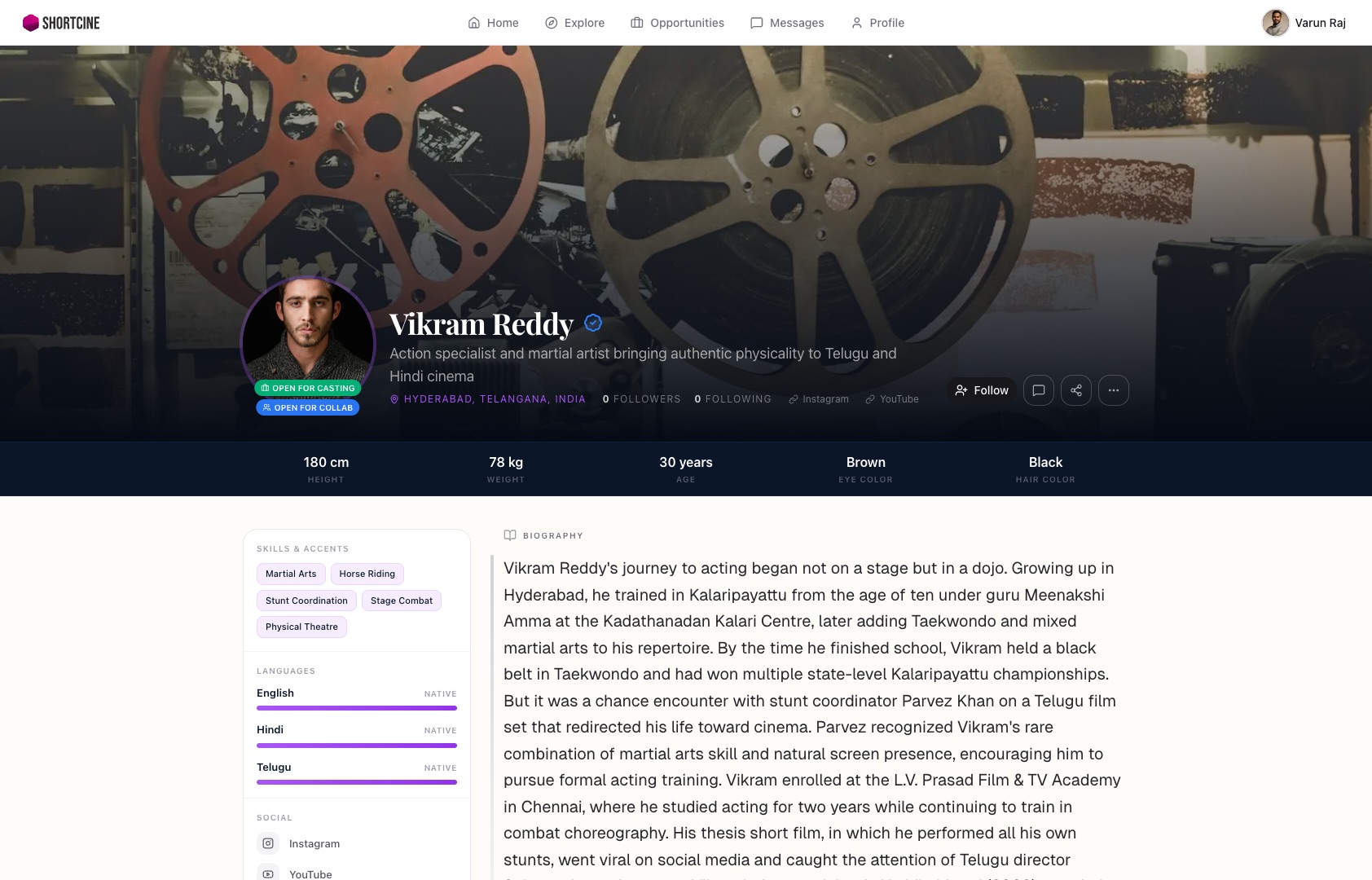
Your portfolio should live at one URL. A simple website, a ShortCine profile, a Casting Networks page. Somewhere that a casting director can open on their phone at midnight, scroll through your photos, tap your reel, and see everything they need in under two minutes.
Do not send a Google Drive folder with seventeen files. Not a PDF that takes four minutes to download on Mumbai's network. Not a WeTransfer link that expires in seven days.
One link. Clean. Fast-loading. Mobile-friendly.
What to skip entirely
Paid portfolio packages from studios. You know the ones. They charge Rs 15,000 to Rs 50,000 for a "professional portfolio" that includes dramatically lit photos, a highlight reel set to cinematic music, and a printed booklet. These look identical to every other portfolio that came from the same studio. Casting directors recognize them instantly. Save your money.
Workshop certificates. Nobody in a casting office cares that you completed a weekend workshop. If the training was good, it'll show in your work. The certificate itself means nothing.
Long bios about your passion for acting. "From a young age, I was drawn to the magic of cinema..." Stop. They don't read these. They never read these. If you must include a bio, keep it to two lines. Where you're from, what training you've done, what languages you speak.
Your Instagram page as your portfolio. Instagram is useful for other things, but it's not a portfolio. Your feed is a mix of selfies, food photos, reels with trending audio, and the occasional behind-the-scenes shot. A casting director needs organized, professional information. Instagram doesn't give them that. Use it for visibility, not for submissions.
The real test
Here's how to check if your portfolio works. Send the link to someone who doesn't know you. Ask them: in thirty seconds, can you tell what I look like, how old I am, what languages I speak, and whether I can act? If the answer to any of those is no, fix it.
Your portfolio is not a creative expression of your artistic journey. It's a tool. Its only job is to get you in the room.
Once you're in the room, your talent takes over. But you need to get in the room first, and a sloppy portfolio is a closed door.
A note on updating
Your portfolio is not a one-time project. Every time you shoot something new, update your reel. Every six months, reshoot your photos. Your look changes, sometimes a lot. If your headshot is two years old, it's lying about you.
Set a reminder. Every six months. Update the photos, swap in any new footage, make sure the link still works. That's the whole maintenance plan.
Keep it honest and keep it current. Most actors don't even do that much.
Your career deserves a better home than a WhatsApp group.
Stop sending PDFs and bulky video files. One professional link for your entire portfolio.