Guide
How to Create an Industry-Ready Digital Acting Portfolio and Showreel
Casting directors spend under a minute on your portfolio. Here is exactly what goes into a professional digital acting portfolio and showreel in 2026, and what to cut.
A casting associate with four hundred submissions to sort gives your portfolio somewhere between twenty and sixty seconds. That is the entire budget. Everything you build has to survive that.
Most actors build portfolios for the wrong audience. They build something that expresses who they are as an artist, when the person looking is trying to answer four narrow questions as fast as possible: what do they look like, what can they play, can they act, and can I reach them. Answer those four cleanly and you will outperform far more talented actors with prettier, slower portfolios.
Here is the industry-ready version, component by component.
The four questions your portfolio must answer
Before any of the detail, hold these in mind, because every decision below follows from them.
What do you look like, right now, without styling. What can you plausibly play, in terms of age range, type and language. Can you actually act on camera. And how do I contact you and confirm you are available.
Anything that does not serve one of those four is decoration, and decoration costs you attention you cannot spare.
Photographs: three shots, honestly taken
You need fewer photographs than you think, and better ones.
A primary headshot. Head and shoulders, eye contact with the lens, natural light or simple soft light, plain uncluttered background, minimal makeup, no heavy retouching, no filters. It must look like you on an ordinary Tuesday. The single most common casting complaint is an actor arriving who does not resemble their photograph, and it damages you permanently with that team.
A second headshot with a different quality. If the first is warm and open, make the second neutral or serious. This shows range of presence without needing a costume.
A full-length shot. Plain wall, fitted clothes, neutral pose, arms visible, no props. Casting needs to see your build and proportions, and this is the photograph most people are missing.
That is the core. If you work commercially, add a bright, smiling, minimally styled headshot, because ad casting wants warmth and clean presentation.
What to leave out: heavily styled fashion shoots, moody artistic portraits with half your face in shadow, anything with a costume from a role, group photographs, and anything more than about eighteen months old or from before a significant change in your hair or build.
The showreel: ninety seconds, best thing first
The showreel is where most actors lose the job, usually through length and structure rather than performance.
Keep it under ninety seconds. Sixty is often better. Nobody watches three minutes. If your reel is long because you want to include everything, understand that including everything means they see the weakest thing.
Open with your strongest ten seconds. Not a title card. Not a montage. Not a slow build. Your best moment, immediately. The decision to keep watching happens in the first few seconds, so a reel that saves its best work for the ninety-second mark has thrown away the one advantage it had.
Lead with close, dialogue-driven work. Casting wants to see your face thinking. Wide action shots, montages cut to music, and beautifully graded shots where you are barely visible tell them nothing about whether you can act.
Show two or three registers, not six. A dramatic scene, something lighter, and if it is genuinely strong, something in a second language. Three well-chosen clips beat eight fragments.
Use whole moments, not one-line flashes. A twenty-second scene where something changes on your face is worth more than ten two-second cuts. Rapid cutting signals that there is nothing sustained to show.
Only include footage you are actually good in. A weak clip does not add credibility, it caps your ceiling. Cut it.
Skip the title cards and the credits crawl. A small name in the corner at the start is enough. Every second of card is a second of your own reel you spent on nothing.
No music bed over dialogue. It is a common instinct and it makes you sound like a trailer instead of an actor.
If you have no professional footage, a purpose-shot reel is completely acceptable and everyone knows what it is. Two contrasting monologues or scenes, shot well, close, with clean sound and a reader off camera. That is far better than nothing and better than bad footage from a project you were poorly used in.
The written profile: casting data, not a biography
Casting associates filter on fields before they look at faces, so the boring information is doing the heaviest lifting in your entire portfolio.
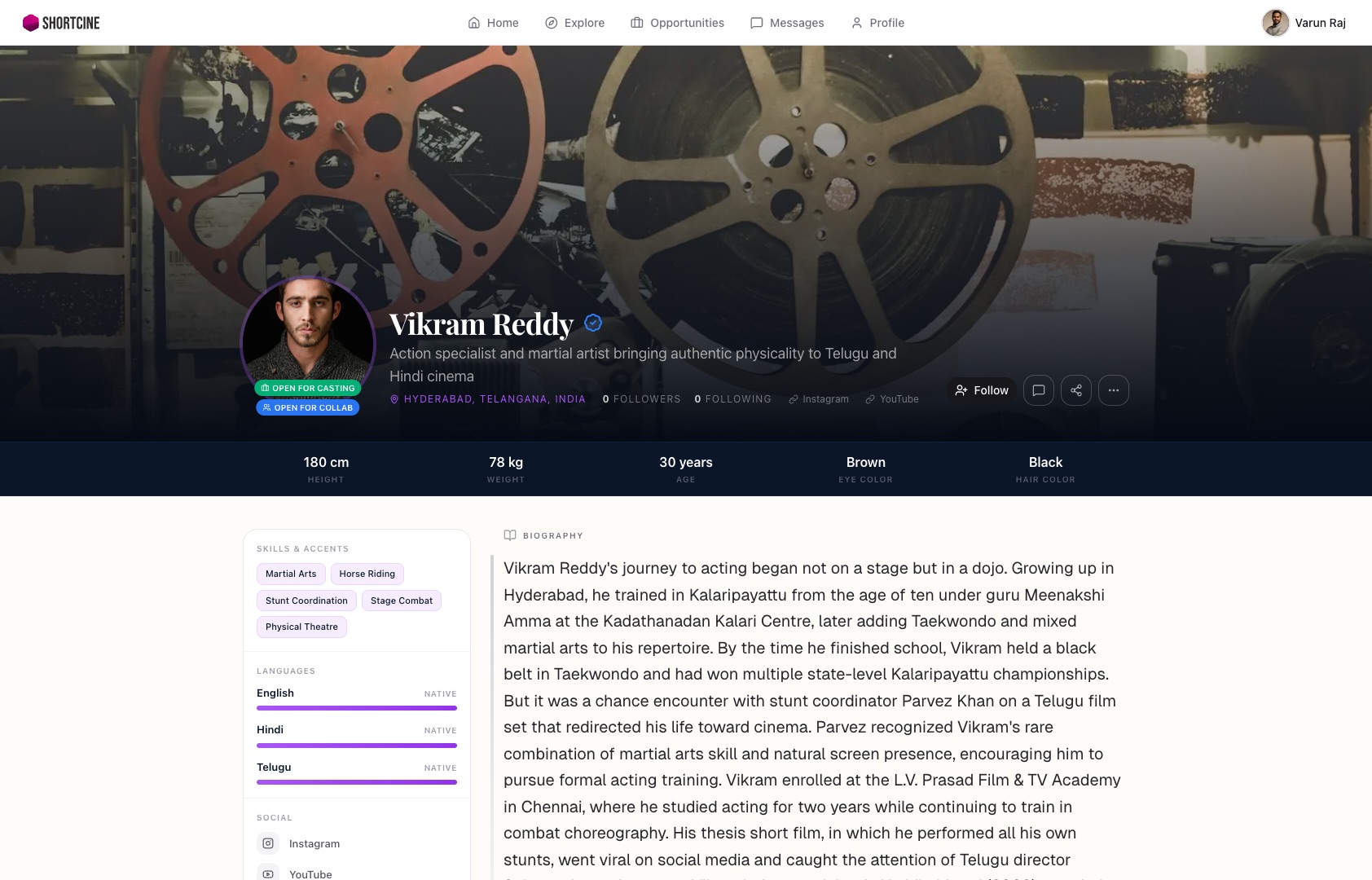
Include your real age and, separately, the age range you can convincingly play. Your height. Your build. Your city and whether you will travel. Every language with an honest fluency level, and every dialect by name, distinguishing performance-level fluency from conversational ability. Your training, including schools, teachers and workshops. Special skills that are genuinely usable on camera: driving, swimming, riding, martial arts, dance forms, instruments, sports, at the level you actually have.
Then a short summary, three or four sentences, that reads like casting information rather than an artist's statement. Who you read as on camera, what you can perform in, where you are, what you have trained in.
And credits, listed plainly: project, role size, director or production house, year. Do not inflate them. Everyone can check, and being caught is worse than having a short list. A short honest list of real work reads as professional. A padded one reads as desperate.
Contact and availability
Astonishing numbers of portfolios make this hard. A working phone number, a professional email you actually check, and a clear indication of availability. If you are represented, the agent's details. If not, do not pretend otherwise.
Reply speed is part of your portfolio in practice. Casting windows close in days, and the actor who answers in two hours gets seen.
Where it should live
Have a complete profile on the casting platforms your industry actually uses, because that is where casting associates run their filtered searches and it is the version of your portfolio that most often gets seen without you knowing.
Have one link you can send that contains everything: photographs, reel, statistics, credits and contact. It should open instantly on a phone, with no downloads, no sign-in, no password.
Keep a professional social presence, since directors will look you up after meeting you, and a private account with no information kills the interest that conversation created.
And keep a self-tape kit permanently ready, because the portfolio gets you considered and the tape gets you cast. A lit corner, a tripod at eye level, a plain wall, a quiet room and a reader on call.
What to cut
Long reels. Slow montage openings. Music over dialogue. Title cards. Group photographs. Heavily stylised or filtered images. Outdated photographs. Vague language claims. Padded credits. Artist's statements about your journey. Downloadable PDF-only portfolios. Anything that requires a login to view.
Almost every improvement to an acting portfolio is a subtraction.
The maintenance habit
Portfolios go stale invisibly. Set a reminder twice a year to reshoot photographs if anything about your appearance has changed, add any new footage worth having, remove the weakest clip on your reel each time you add a stronger one, update your credits and your availability, and check that every link still opens on a phone.
The actors who get called consistently are rarely the ones with the most beautiful portfolios. They are the ones whose portfolio is current, honest, fast to read, and answers all four questions in under a minute.
Frequently asked questions about acting portfolios and showreels
How long should an acting showreel be? Under ninety seconds, and often sixty is better. Lead with your strongest moment rather than a title card or montage.
What photographs does an actor actually need? A natural primary headshot, a second headshot with a different quality, and a plain full-length shot in fitted clothes against a neutral background.
What if I have no professional footage? Shoot a purpose-made reel with two contrasting scenes or monologues, framed close, with clean sound and an off-camera reader. It is completely standard and better than weak footage.
How often should a portfolio be updated? At least twice a year, and immediately after any significant change to your hair, build or appearance, since photographs that no longer match you are a common reason submissions fail.
Should the reel include music and titles? No music over dialogue, and no more than a brief name credit. Both consume the limited attention the reel has to work with.
Your career deserves a better home than a WhatsApp group.
Stop sending PDFs and bulky video files. One professional link for your entire portfolio.